

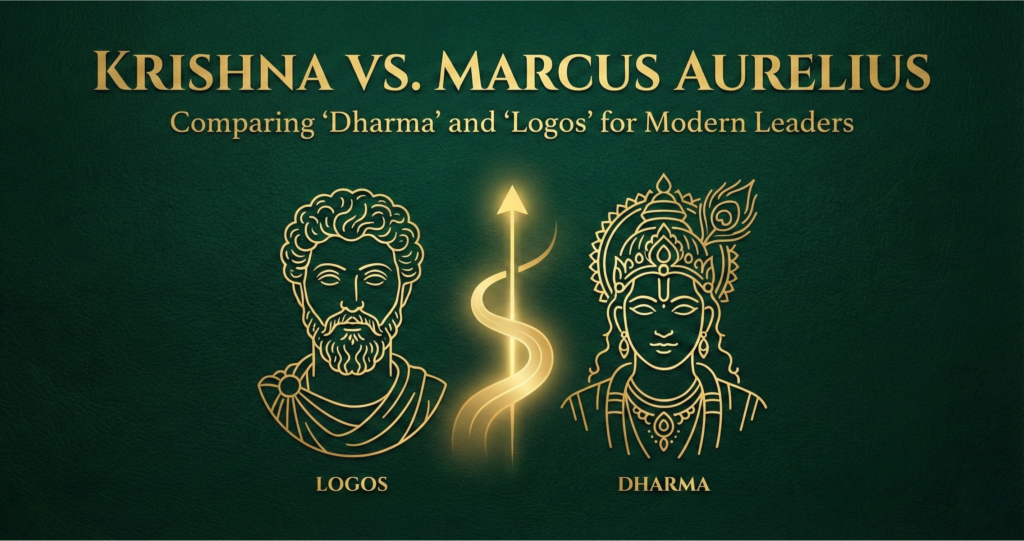
If you are a high-performer, you’ve likely read Meditations by Marcus Aurelius. Stoicism has become the “Silicon Valley Religion” because it promises emotional resilience in a chaotic world.
But there is an older, more dynamic framework that world leaders are turning to: The Bhagavad Gita.
While Marcus Aurelius (the Emperor) and Krishna (the Charioteer) both teach resilience, they approach it through two different lenses: Logos and Dharma. Understanding the difference is the key to moving from “Enduring the Day” to “Mastering the Battlefield.”
🏛️ The Stoic ‘Logos’ (Accepting the Universe)
Marcus Aurelius taught that we must align ourselves with Logos – the rational order of the universe. To a Stoic, happiness comes from realizing what is outside your control and accepting it with a calm mind.
- The Goal: Apathia (Freedom from suffering through indifference).
- The Leadership Style: The “Patient Observer.”
🏹 The Vedic ‘Dharma’ (Engaging the Battle)
Krishna takes it a step further. He doesn’t just ask Arjuna to accept the battle; he commands him to engage it with total intensity. This is the path of Dharma – your inherent duty.
- The Goal: Nishkama Karma (Action without attachment to the fruit).
- The Leadership Style: The “Detached Warrior.”
The Key Difference: Passive vs. Active
Stoicism is often defensive. It’s about building a shield so the world doesn’t hurt you. Dharma is offensive. It’s about recognizing your specific role in the cosmic order and playing that role with 100% excellence, regardless of the outcome.
Marcus says: “Accept what happens.” Krishna says: “Act, because it is your nature to act.”
Why the Gita is the ‘Upgrade’ for 2026
In a modern corporate environment, “Acceptance” can sometimes lead to passivity or “Quiet Quitting.” Dharma provides the fire. It gives you a reason to wake up and fight, even when the odds are against you, because the work itself is the reward.
Ready to find your Dharma? Start the 30-Day Gita Challenge today.