

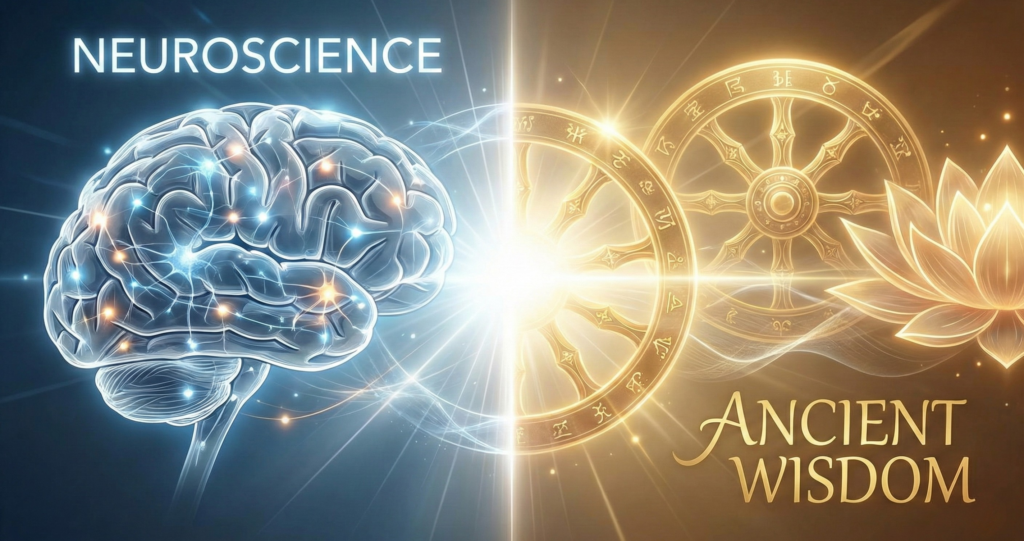
At shribhagavadgita.com, we make a bold claim: The Bhagavad Gita is not just a holy book; it is the world’s oldest manual on cognitive science.
For centuries, this might have sounded like a metaphor. But in 2026, modern neuroscience and psychology are finally catching up to what Krishna taught on the battlefield 5,000 years ago.
You don’t need faith to use the Gita Framework. You just need to understand the mechanics of your own mind. Here is the science behind the system.
1. The Chariot & Cognitive Behavioral Therapy (CBT)
The core of modern therapy is CBT (Cognitive Behavioral Therapy). Its primary goal is “Metacognition” – the ability to step back and observe your thoughts rather than being possessed by them.
- The Science: CBT teaches you to separate the “Stimulus” from the “Response.”
- The Gita: This is the exact model of the Chariot. The “Horses” (Senses/Emotions) pull toward a stimulus. The “Driver” (Buddhi/Intellect) intervenes to choose the response.
- The Verdict: When you practice the Driver Awakening Protocol, you are essentially performing a rapid, self-directed CBT session to regulate your amygdala (fear center).
2. Neuroplasticity & “Samskaras”
Why is it so hard to break a bad habit? Neuroscience points to Hebbian Learning: “Neurons that fire together, wire together.” Every time you react with anger or anxiety, you physically thicken that neural pathway.
- The Gita: Krishna calls these pathways Samskaras (mental impressions). He warns that acting out of anger (Rajas) creates a deep groove in the mind that makes future anger more likely.
- The Solution: The Gita’s practice of Abhyasa (constant practice) is what neuroscientists call “Directed Neuroplasticity.” By consciously choosing a different response (using the Driver), you physically rewire your brain’s default mode network.
3. Flow State & Nishkama Karma
In the 1990s, psychologist Mihaly Csikszentmihalyi defined “Flow” as the optimal state of human performance.
- The Science: Flow happens when “Transient Hypofrontality” occurs – the prefrontal cortex (the inner critic) temporarily shuts down, and you become one with the task. This usually happens when the challenge matches the skill level.
- The Gita: This is Nishkama Karma. By “detaching from the fruit” (the result), you silence the inner critic (the ego). When you are no longer worried about the outcome, your brain enters the Flow State instantly.
- The Verdict: The Gita was teaching Flow State triggers thousands of years before modern psychology named them.
4. The Physiology of “Sattva”
We often talk about “Vibes” or energy. The Gita classifies this as the 3 Gunas.
- Rajas: High Cortisol / Adrenaline (Stress/Anxiety).
- Tamas: Low Dopamine / Brain Fog (Depression/Inertia).
- Sattva: Balanced Serotonin / Acetylcholine (Clarity/Focus).
Our entire framework is designed to bio-hack your system out of Rajas (Stress) and Tamas (Laziness) into Sattva – the biological state of peak performance.
You don’t need a PhD to practice this. You just need a protocol. Download the 30-Day Action Blueprint to start rewiring your brain today.