

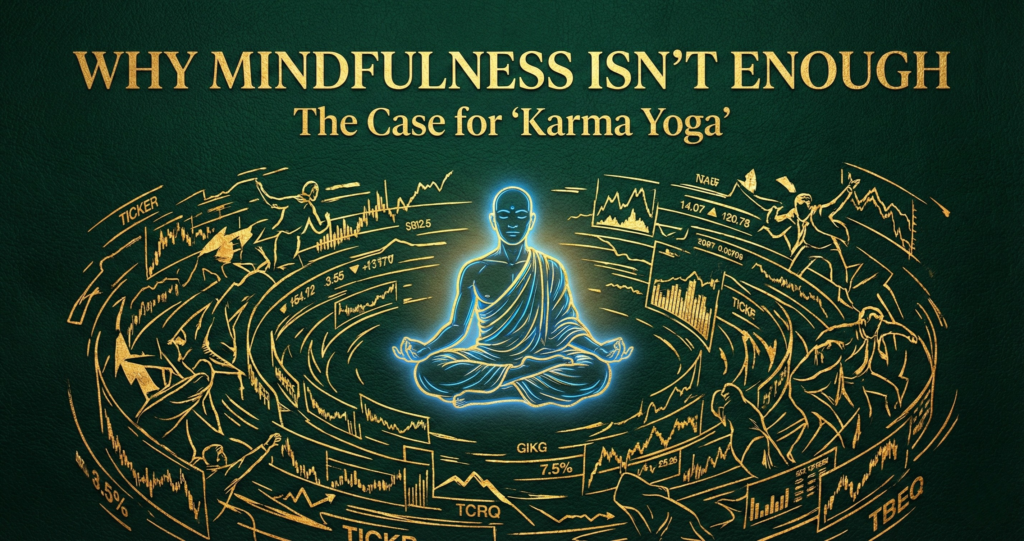
We have all been there. You do your 10 minutes of guided meditation in the morning. You feel calm. You feel centered.
Then, you walk into the office, your boss yells at you, and – poof – the calm is gone.
The problem with the modern “Mindfulness” movement isn’t that it doesn’t work. It does. The problem is that it is Passive. It teaches you how to find peace away from the noise.
But what happens when you have to step back into the noise?
For high-performers, “Sitting Still” is not enough. You need a form of meditation that works while you are moving, arguing, and deciding. You need the Vedic science of Karma Yoga (The Yoga of Action).
While Ancient Wisdom for Modern Stress offers a complete system, modern mindfulness often falls short.
🧠 Key Takeaways
- The Limitation: Mindfulness creates a “gap” between you and your stress. But that gap closes the moment you have to make a high-stakes decision.
- The Upgrade: Karma Yoga is “Action-Meditation.” It brings the meditative state into the work itself, rather than escaping it.
- The Metaphor: Mindfulness is watching the river from the bank. Karma Yoga is swimming in the rapids without drowning.
The “Calm App” Paradox
Mindfulness teaches you to be an Observer. You watch your thoughts like clouds passing in the sky. This is excellent for lowering cortisol and detaching from anxiety.
But you cannot “watch your thoughts” when you are negotiating a million-dollar contract. You have to think. You have to judge. You have to act.
This is why so many professionals feel a “split personality”: They are a Monk in the morning and a Maniac in the afternoon.
Enter Karma Yoga: Meditation in Motion
The Bhagavad Gita was not spoken in a cave. It was spoken on a battlefield – the ultimate high-stress environment.
Krishna tells Arjuna: “Perform your duty equipoised, abandoning all attachment to success or failure.” (Gita 2.48).
This is Karma Yoga. It asks you to enter a state of “Flow” where you are intensely focused on the task, but completely detached from the result of the task.
The Difference in Real Life
| Scenario | The ‘Mindful’ Approach | The ‘Karma Yoga’ Approach |
| The Trigger | A rude email from a client. | A rude email from a client. |
| The Tactic | “I will take a deep breath and observe my anger.” | “I will view this reply as a test of my skill, not an attack on my ego.” |
| The Action | Step away from the computer to calm down. | Type the reply immediately, but with zero emotional attachment. |
| The Result | You feel better after the break. | You feel peace during the work. |
Why You Need Both
We are not saying you should delete your meditation app. Mindfulness is the Training Ground. It builds the muscle of focus.
But Karma Yoga is the Game Day. It applies that focus to the real world.
If you are suffering from Arjuna Syndrome, sitting still might actually make your anxiety worse (because you are just sitting there thinking about your to-do list). You need to move. You need to act. But you need to act with a specific internal software.
Mindfulness builds awareness, much like Stoicism builds endurance, but neither of them generates the dynamic flow state of Karma Yoga.
Conclusion: Don’t Escape the Battlefield
The goal of life is not to find a cave where no one bothers you. The goal is to find a center that no one can disturb.
Stop trying to breathe your way out of your career. Start acting your way through it.
Ready to learn the protocol?
We teach the specific techniques of Karma Yoga in our 30-Day Gita Challenge Blueprint.