

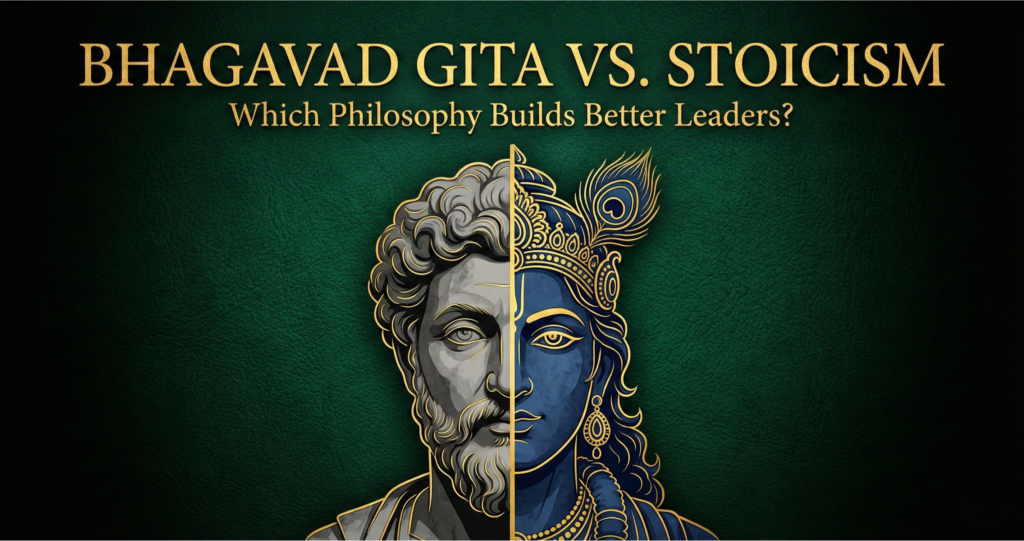
Walk into any CEO’s office in 2026, and you will likely find a copy of Meditations by Marcus Aurelius. Stoicism has become the unofficial religion of Silicon Valley.
And it makes sense. Stoicism teaches you to be an “Iron Man” – unshakeable, rational, and tough.
But there is a flaw in the Iron Man suit.
Stoicism is excellent for surviving stress (“Grin and bear it”), but it often fails at transforming stress. This is where the Bhagavad Gita offers a critical upgrade. While both philosophies agree that “You cannot control the event, only your reaction,” the Gita takes you one step further – from Endurance to Devotion.
This comparison is part of our wider guide on Ancient Wisdom for Modern Stress.
🧠 Key Takeaways
- The Common Ground: Both systems teach the “Dichotomy of Control” – focusing only on what is in your power.
- The Difference: Stoicism relies on Willpower (The Ego holding on). The Gita relies on Surrender (The Ego letting go).
- The Verdict: Stoicism prevents pain; the Gita generates Bliss (Ananda) even in the middle of pain.
Round 1: The View on Emotions
The Stoic Approach: Apatheia (Equanimity).
Stoics view strong emotions as “errors of judgment.” If you are angry or sad, it is because you misjudged reality. The goal is to suppress or rationalize the emotion until you are calm.
- The Risk: Emotional suppression. You become “numb” rather than peaceful.
The Gita Approach: Samatvam (Evenness of Mind).
Krishna does not ask Arjuna to stop feeling. He asks him to consecrate the feeling.
- The Upgrade: Instead of suppressing anger, you channel it into Dharma (Duty). You don’t kill the emotion; you aim it.
While Stoicism deals with controlling emotions, other methods focus on observing them. Read our breakdown of Why Mindfulness Isn’t Enough to see how that approach compares.
Round 2: The Source of Strength
The Stoic Approach: Self-Reliance.
“You have power over your mind – not outside events.” The Stoic draws strength from their own rational mind.
- The Limitation: What happens when you are exhausted? If your willpower runs out, your Stoicism collapses.
The Gita Approach: Divine Reliance (Ishvara Pranidhana).
The Gita teaches that you are not the generator of power; you are a conduit. By practicing Bhakti (Devotion) or Sankhya (Knowledge), you tap into a source of energy larger than your own ego.
- The Upgrade: Infinite energy. You don’t burn out because you aren’t fueling the car with your own gas.
Round 3: The End Goal
Stoicism: Ataraxia (Tranquility/Freedom from worry).
The goal is to be undisturbed. A Stoic sage is like a rock in a storm – unmoved.
The Gita: Nishkama Karma (Selfless Action in Flow).
The goal is not just to be “undisturbed,” but to be dynamically engaged. A Yogi is not a rock; a Yogi is a dancer in the storm.
- The Upgrade: The Gita is better for Creative Leaders and Innovators who need passion, not just stability.
Conclusion: Don’t Just Endure. Evolve.
Stoicism is the perfect “Field Medic” – it stops the bleeding when you are in crisis. But the Bhagavad Gita is the “General” – it tells you how to win the war.
If you have mastered the Stoic art of “Not letting things bother you,” it is time to graduate to the Vedic art of “Letting things move through you.”
Which one do you need right now?
- If you are drowning in chaos → Start with Stoicism.
- If you are numb and need purpose → Move to The Gita Framework.
Ready to upgrade? Learn how to apply these principles in our 30-Day Gita Challenge Blueprint.